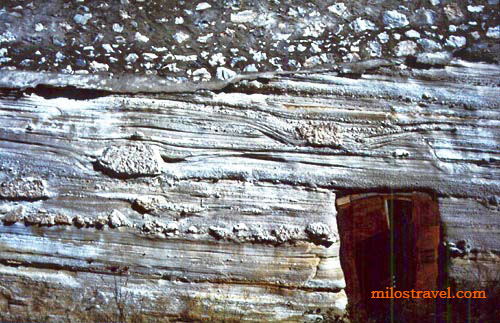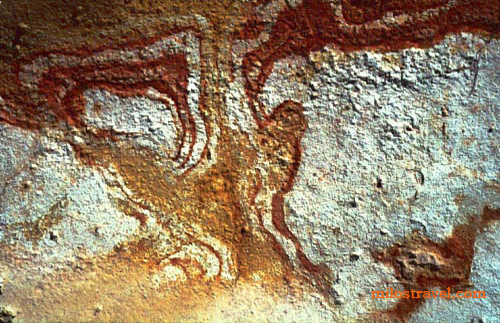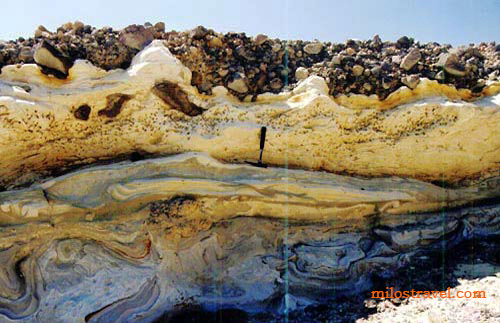
Milos Geology. The geological nature of the archipelago is the main reason for its fabulous variety of colors and landscapes. Milos and the nearby islands belong to an important volcano's alignment called 'Aegean Volcanic Arc' formed by the subduction of the African plate under the Aegean area. This arc goes from the golf of Korinthos to the west cost of Turkey.
The main volcanic districts are represented by: Methana-Poros, Milos, Nysiros and Santorini , this latter being the only one showing a remarkable volcanic activity over known history.
Milos volcanic district
The Milos volcanic district is a wide volcanic archipelago comprising the islands of Milos, Kimolos, Antimilos and Poliegos.
From the geological point of view, here the volcanic activity started about 5 millions of years ago and it is now considered extinct. Sarakiniko and Mitakas are the result of the rhyolitic volcanism. Milos’ miners have exploited the obsidian since Neolithic age (7000 years ago). In most of the Mediterranean countries, one may find obsidian that came from Milos.
The andesitic rocks, usually dark in color, outcrop in the area of Fylakopì and Pollonia and in the Southwest portion of Milos. It is possible recognize both lava domes and dike set with spectacular columnar jointing originated during the thermal cooling of the lava bodies (Glaronissia, Kalogero).
Following their emplacement, volcanic rocks were involved by an intense hydrothermal activity. This kind of physical-chemical process is responsible of remarkable changes in the chemical composition of the original rocks, with the formation of huge ore deposit of clay minerals. Their exploitation represents a considerable source in the Milos economy. During the 80's Greece was the 2nd world producer in bentonite, a valuable variety of clay deposit. This post-volcanic alteration increases the extreme variety of color and landscape of Milos Island (beaches of Fyriplaka, Fyropotamos and Plathiena).
The volcanic nature of Milos
The volcanic nature of Milos is responsible for an anomalous heat flux in the earth crust. In geology, these areas, called 'geothermal fields', could be exploited to produce energy. Unfortunately or not, this favorable geological situation of Milos has not been utilized yet.
In the areas of Katifora (above Adamas) and of Zephiria you may see closed wells and the remains of pipelines. In the 80’s international companies initiated a project to exploit geothermal fields but, after the blast of one of the wells, the Milos population decided to reject exploiting projects that would somehow endanger their lives. The same happened with the exploitation of gold in the area of Profitis Elias.
Lovers of geology may visit the interesting ‘Mining Museum of Milos”, located in Adamas, a tribute to all Milos miners over the island’s history.
Glossary